
A cleaning scope of work for a vacation rental is a guest-ready checklist that pairs room-by-room tasks with time-stamped, photo-verified inspection rules, and clear acceptance criteria. Skip any one of those three pieces and you're left guessing whether a cleaner actually finished the job or just said they did.
Paste this into your next cleaner agreement or job posting:
- Room-by-room tasks and par levels — what gets cleaned, restocked, and to what standard in every space.
- Required photos and naming convention — a timestamp on every image, tied to the property and reservation.
- Acceptance criteria and escalation path — the specific line that must be true before a job counts as done, and what happens when it isn't.
A turnover clean typically runs one to three hours and costs $150 to $300, depending on property size, so the scope needs to be tight enough to hit that window without cutting corners. Turnivia's Airbnb turnover and deep clean checklist templates already build these three elements in, so you're customizing rather than starting from a blank page.
Table of Contents
- Room-By-Room Scope: What Tasks to List for Every Turnover
- What Photos Does a Turnover Inspection Actually Require?
- How Long Should a Turnover Take, and What Should It Cost?
- How Do You Enforce the Scope Across Different Cleaners?
- How to Write a Cleaning Scope of Work in Six Parts
- How Turnivia Puts the Scope Into Practice
- The Gap Between a Checklist and an Actual Standard
- Sources
Room-By-Room Scope: What Tasks to List for Every Turnover
Vague instructions like "clean the kitchen" produce inconsistent results because every cleaner defines "clean" differently. A working scope spells out the task and, where it matters, the standard that proves it's done.
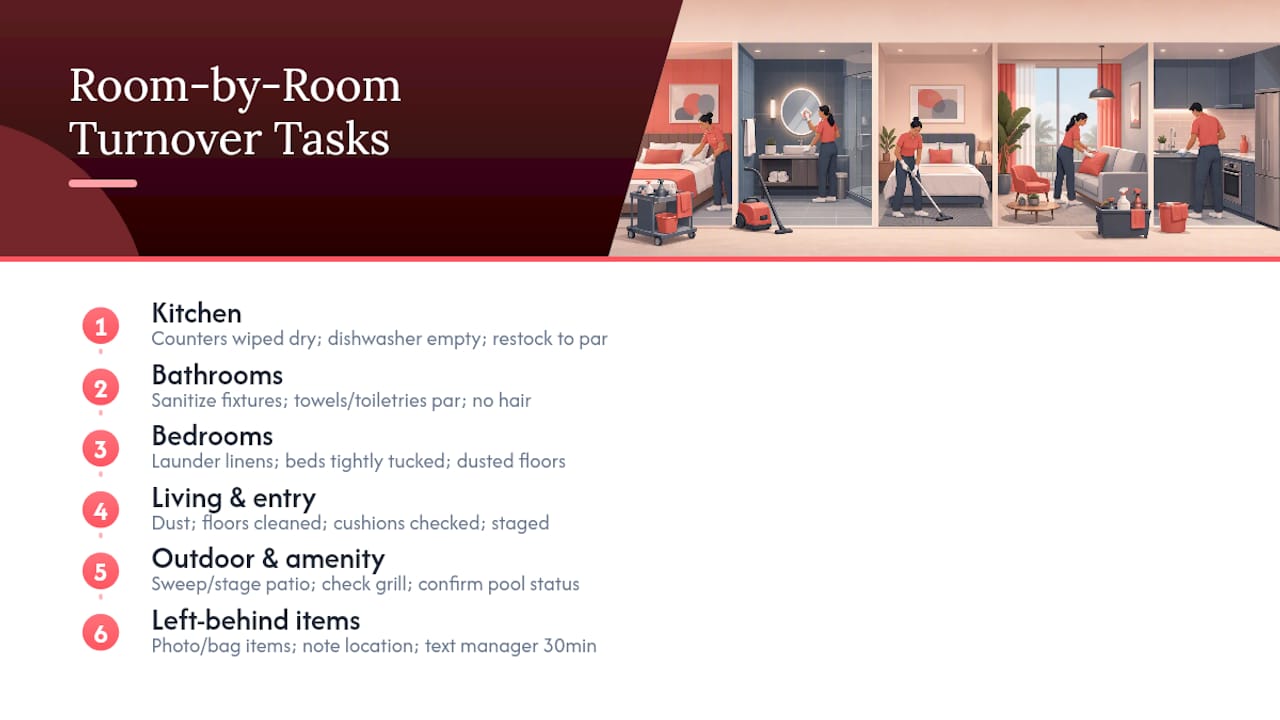
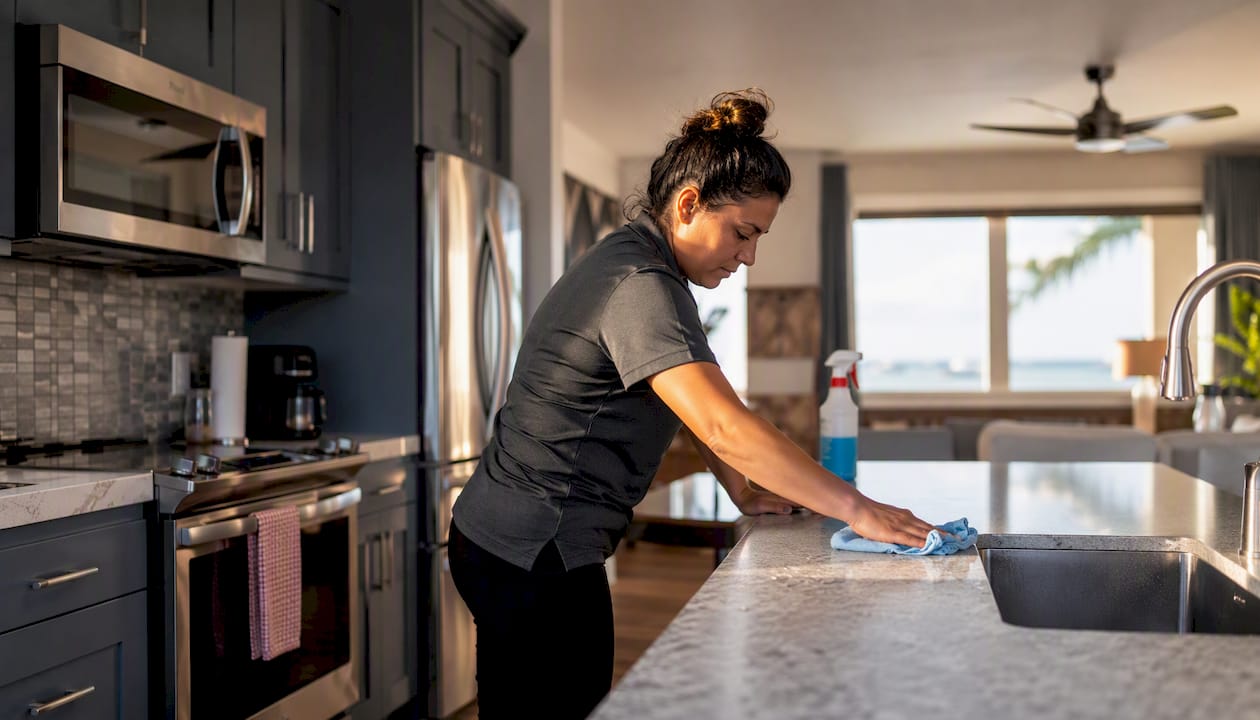
Kitchen. Sanitize counters and the sink, empty the dishwasher, wipe appliance exteriors, and check inside the microwave and fridge if guests use them. Restock consumables to a fixed par (two dish pods, one roll of paper towels) and reset the trash with a fresh liner. Sample acceptance line: "counters wiped and dry, no crumbs or residue; dishwasher empty; trash bin lined and empty."
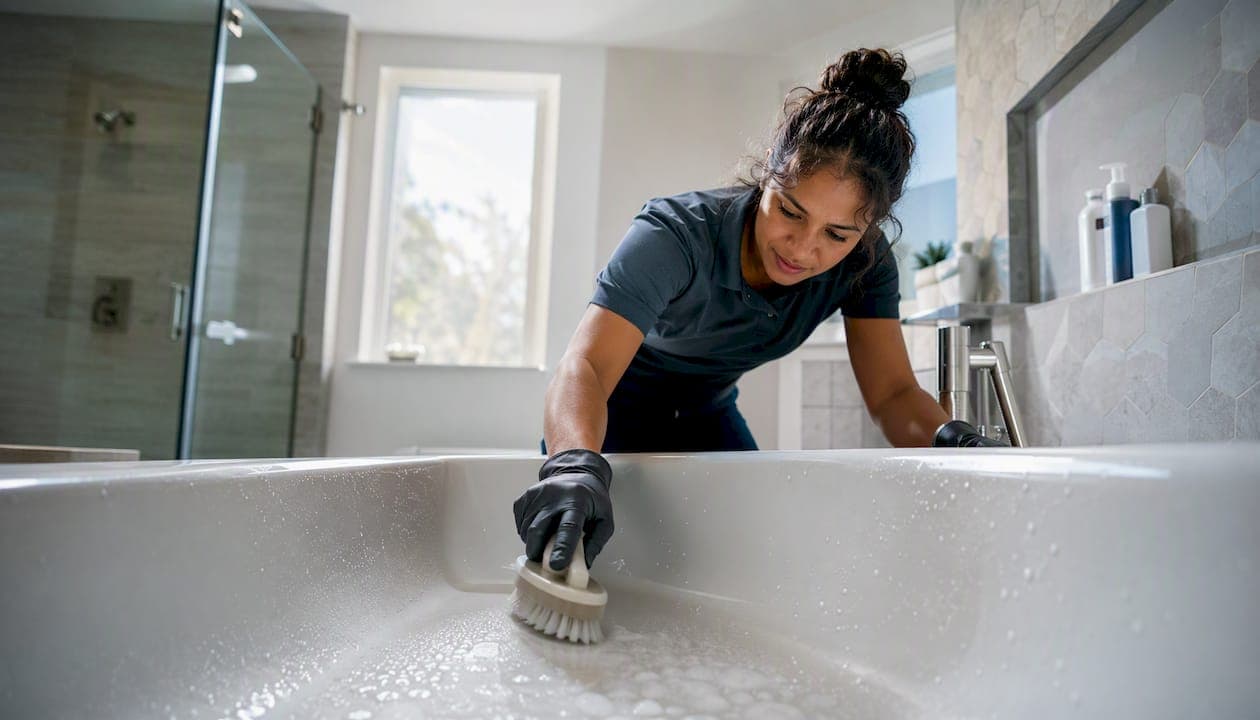
Bathrooms. Sanitize the toilet, tub or shower, sink, and mirror. Replace all towels and restock toiletries and toilet paper to par. Check grout lines and drains for hair or buildup. Sample phrasing: "no visible hair in tub or on floor; mirror streak-free; toilet bowl and base clean."
Bedrooms. Strip and launder every linen set, remake beds to a defined standard ("tightly tucked, hospital corners where specified"), dust all surfaces, and check under beds and inside drawers for items left behind. Vacuum or mop before staging.
Living and entry areas. Dust top to bottom, vacuum or mop, and check under couch cushions, which is one of the most consistently missed spots in any turnover. Stage furniture to match your reference photos, and sanitize remotes, light switches, and door handles.
Outdoor and amenity areas. Sweep and stage the patio or balcony, check grill cleanliness if one's provided, and confirm pool or hot tub status against your safety checklist.
Your scope should also spell out what happens to items guests leave behind: where they're stored, how long you hold them, and how the cleaner reports a find. A one-line rule like "photograph and bag any found item, note the location, and text the manager within 30 minutes" removes the guesswork.
Pro Tip: Specify exact par levels for consumables (towel counts, coffee pods, toilet paper rolls) but leave technique alone. Telling a cleaner exactly how many towels to leave prevents disputes; telling them exactly how to fold them just slows everyone down.
What Photos Does a Turnover Inspection Actually Require?
Photos only work as proof if they follow a consistent shot list, and a standardized shot list with timestamps and structured file names is what lets a host pull up any stay's documentation in seconds instead of digging through a camera roll.
The shot list, room by room:
- One wide shot per room for context (kitchen, living room, each bedroom, each bathroom).
- A close-up inside the microwave and fridge if guests access them.
- A close-up under sofa cushions.
- A close-up of the toilet bowl and shower floor.
- A wide shot of any outdoor space included in the stay.
Naming and timing matter as much as content. A file like PROP204_RES88231_2026-03-14_bathroom-01.jpg ties the photo to a property, a reservation, and a date at a glance, and photos should always be taken after cleaning and staging are complete, never mid-clean.
The workflow that makes this stick:
- The cleaner works through the photo checklist on site, room by room.
- Timestamped photos attach automatically to the reservation record.
- The property manager reviews the report within an agreed window, typically under an hour for same-day turns.
- Any red-flag photo (a stain, a missing item, visible damage) triggers escalation before the next guest arrives.
Pro Tip: Require both a wide shot and a close-up for anything questionable, plus a short text note. "Stain pre-existed, maintenance request submitted" turns a photo into a documented decision instead of a mystery someone has to reconstruct later.
How Long Should a Turnover Take, and What Should It Cost?
Smaller units typically require less than a couple of hours to turn, while larger properties take longer Standard turnover pricing lands between $150 and $300, with deep cleans, heavy maintenance issues, or elaborate staging pushing costs above that range.
Same-day turns are where scopes get tested hardest. A fixed task order helps: strip beds and start the laundry load first, take out trash, work top to bottom through each room, then run the final photo inspection last. That sequencing means the washer is running while the cleaner tackles bathrooms instead of everyone waiting on linens at the end.
A few operational habits shrink turnover time without cutting corners:
- Automate scheduling so a booking confirmation triggers the cleaner assignment immediately.
- Keep a backup cleaner on call for short-notice same-day turns.
- Separate deep cleans (every three to six months) from standard turnovers so routine turns stay fast.
Hosts using Turnivia report saving 20 to 40 minutes per turnover simply by cutting the back-and-forth checking that eats up manager time when reports live in text threads and phone photos instead of one system.
How Do You Enforce the Scope Across Different Cleaners?
A scope of work is only as good as the quality control behind it. Photo checks on every single turnover, not just spot audits, are what raise the baseline standard because cleaners know the work will be reviewed every time, not occasionally.
Layer in a weekly sampling of completed reports even when nothing's flagged. Pull five random turnovers and actually look at the photos. Patterns show up fast, like the same cleaner consistently skipping the under-cushion shot or the same property having a recurring streak on the shower door.
Training works best paired with a visual reference. A written SOP tells a cleaner what to do; photos of an "acceptable" made bed next to an "unacceptable" one show them what you actually mean. New cleaners should run a probationary period with extra spot checks until their reports consistently match expectations.
Set clear red flags that trigger escalation: missing timestamps, repeated photo-count misses, a recurring stain or damage report, or late uploads on a same-day turn. A sample escalation path: retrain with the reference photos → written warning → hold pay pending resolution → termination for repeated violations.
Pro Tip: Require the cleaner to finish the entire photo checklist before they leave the property. It cuts callback trips in half and turns "I'll fix it next time" into "fix it now, while you're standing there."
How to Write a Cleaning Scope of Work in Six Parts
A usable scope fits on one page. Structure it like this:
- Objective — one sentence stating the goal ("Prepare Unit 204 to guest-ready standard between checkout and next check-in").
- Scope — which rooms and areas are covered.
- Task list per room — short, specific bullets, not paragraphs.
- Photo and timestamp rules — the shot list and naming convention.
- Acceptance criteria — the sentence that must be true for the job to count as complete.
- Escalation and lost-and-found process — what happens when something's wrong or a guest item turns up.
A condensed example:
Objective: Turn Unit 204 to guest-ready standard within 2.5 hours of checkout. Scope: Kitchen, two bathrooms, two bedrooms, living room. Bathroom: sanitize toilet, tub, sink, mirror; replace towels; restock to par. Photos: one wide shot per room, close-up under couch cushions, close-up of each toilet bowl. Filename: property code + reservation ID + date. Acceptance: "No visible hair in bathtub; mirror streak-free; trash bins emptied and lined; all linens replaced with clean, unstained sets."
That last sentence is the whole point of a scope. It's the line a cleaner can check themselves against before calling the job done, and the line a manager can check a photo against if a guest complains. Turnivia's free checklist library has templates already structured this way, and each one has blank fields for your own par levels and property-specific notes.
How Turnivia Puts the Scope Into Practice
Writing the scope is half the job. Getting cleaners to actually follow it, every time, on every property, is the harder half, and it's where most manual checklists break down.
Turnivia's workflow runs in five steps: build or import a checklist, attach it to a property, let a new booking auto-generate the job, have the cleaner scan a QR code to open the checklist on site, and get an instant PDF report the moment they finish. No app download for the cleaner, which matters more than it sounds, since on-site checklists completed by the cleaner before they leave scale better than manager visits after the fact.
What that setup gets you:
- Time-stamped photo verification tied to each reservation.
- Before-and-after photo pairs for disputed areas.
- Instant PDF reports you can forward straight to a property owner.
- QR-code access, so cleaners need nothing installed on their phones.
- Offline mode, so a weak signal at a remote property doesn't stall the job.
Start with one property and one checklist. Run it for two weeks with photo uploads mandatory before a job can close, then expand once you've seen how it holds up. The Airbnb turnover template is the fastest starting point if you manage short-term stays.
The Gap Between a Checklist and an Actual Standard
Most hosts think they have a scope of work because they have a checklist. They don't. A checklist tells a cleaner what to touch; a scope tells them what "done" looks like and gives you proof it happened. That distinction is where most turnover disputes actually start, not in the cleaning itself but in the absence of a shared, documented definition of guest-ready.
The conventional advice, "hire a good cleaner and trust them," ignores that even excellent cleaners forget things under time pressure, and even reliable ones have off days. Photo verification isn't about distrust. It's about removing the guesswork that turns a five-minute disagreement into a canceled reservation.
Where I'd push back on the industry's current obsession with photo counts: a stack of photos is worthless without a manual check behind it. Treat the shot list as evidence, not as the inspection itself. The host who scans photos for two minutes and calls it quality control is one bad guest review away from realizing a photo isn't the same as a person who actually looked under the couch.
Start with the acceptance criteria, not the app. Get one sentence per room that's specific enough to fail against. Everything else, the templates, the QR codes, the PDF reports, is just infrastructure for enforcing that sentence consistently.
Sources
- Vacation Rental Turnover Cleaning: How to Nail Same-Day Turns (2026) | Hostfully
- Airbnb Cleaning Photo Proof: The Simple System That Ends “It Wasn’t Clean” | STR Specialist